Thursday, September 29, 2005

Ink Scrawl Nugget 9

Hitler at the Crossroads:
The situation in Germany had come up for discussion in the bar parlour of the Angler's Rest, and it was generally agreed that Hitler was standing at the crossroads and would soon be compelled to do something definite. His present policy, said a Whisky and Splash, was mere shilly-shallying.


"He'll have to let it grow or shave it off," said the Whisky and Splash. "He can't go on sitting on the fence like this. Either a man has a moustache or he has not. There can be no middle course."
P.G Wodehouse begins a Mulliner story, Buried Treasure.

From Lord Emsworth and Others, a collection of short stories by P.G. Wodehouse.

Other Wodehouse nuggets here, here, and here.

Also, a post on Wodehouse: The Alternate Universe of P.G. Wodehouse.

Pointless, Incessant Barking . . .

New Yorker's Blogging State of Mind.

Link via Indianwriting.

Pizza Time

Question: What's the opposite of DOMINOS?

Answer: DOMI doesn't KNOW.


Question: What's the opposite of PIZZA HUT?

Answer: PIZZA HUTNA MUT ;-)

---------------
Email forward. Good one. Wot Say?

Wednesday, September 28, 2005

Tight Issue

Sagnik Nandy tackles the tight issue of supehero costumes and explains why none of the superheroes have a smooth love life.

Happy Birthday, Google


Happy Budday Google!

Let's all sing the Google Aarti for the god of search.

Here's wishing that Google comes up with many more services and ideas that help us.
And some quirky ones too that make it so endearing.


Monday, September 26, 2005

Ink Scrawl Nugget 8

On Those who Read Thrillers:
The day on which Lawlessness reared it ugly head at Blandings Castle was one of singular beauty. The sun shone down from a sky of cornflower blue, and what one would really like would be to describe in leisurely detail the ancient battlements, the smooth green lawns, the rolling parkland, the majestic trees, the well-bred bees and the gentlemanly birds on which it shone.


But those who read thrillers are an impatient race. They chafe at scenic rhapsodies and want to get on to the rough stuff. When, they ask, did the dirty work start? Who were mixed up in it? Was there blood, and if so, how much? And - most particularly - where was everybody and what was everybody doing at whatever time it was? The chronicler who wishes to grip must supply this information at the earliest possible moment.
[. . .]
P.G Wodehouse tees off yet another Blandings story, The Crime Wave at Blandings, in his inimitable style.

From Lord Emsworth and Others, a collection of short stories by P.G. Wodehouse.

Other Wodehouse nuggets here and here.

Also, a post on Wodehouse: The Alternate Universe of P.G. Wodehouse.

Friday, September 23, 2005

Friday, September 16, 2005

More Web 2.0

Stephen Downes in a presentation (Powerpoint, MP3): What E-Learning 2.0 means To You, seeks to throw light on:
[. . .] the changing nature of knowledge and learning, illustrate how this changing nature leads to what is being called Web 2.0o, and outline the nature and success factors involved in designing learning resources and services in this environment.
[. . .]
Downes' post, powerpoint, and MP3 audio of the presentation.

Richard MacManus & Joshua Porter in Web 2.0 for Designers, outline the six main themes covering design in the Web 2.0 world:
  1. Writing semantic markup (transition to XML)
  2. Providing Web services (moving away from place)
  3. Remixing content (about when and what, not who or why)
  4. Emergent navigation and relevance (users are in control)
  5. Adding metadata over time (communities building social information)
  6. Shift to programming (separation of structure and style)
According to them:
[. . .]Web 2.0, a vision of the Web in which information is broken up into microcontent units that can be distributed over dozens of domains. The Web of documents has morphed into a Web of data. We are no longer just looking to the same old sources for information. Now we're looking to a new set of tools to aggregate and remix microcontent in new and useful ways.[. . .]
Complete article here.

Other related posts: Web 2.0: the Power Behind the Hype, Why Web2.0 Matters: Preparing for Glocalization, and Computing Means Connecting.

Do Teachers Really Have it Easy?

Uma Mahadevan-Dasgupta in a thought-provoking post: In the Classroom, says:
[. . .]
I’ve always felt that the schoolrooms ought to be the living, joyful centre of a community. That primary education should really, literally, be primary.

But does the community think so? [. . .]
She then raises a number of important questions about the state of education in India: What is it really like in schools across India? Why teachers are treated so poorly? Why do people have such a negative view of teaching and teachers?

Do read this excellent post. And all the links that it points to.

Here's a related post that I had made earlier: Killing Higher Education in India.

Thursday, September 15, 2005

Web 2.0: the Power Behind the Hype

Jared M. Spool provides an excellent primer on Web 2.0. The article gives a lowdown on the technologies that are enabling the Web 2.0 framework: APIs, RSS, Folksonomies, and Social Networking.

Spool also points out that Web 2.0 architecture still needs much work and will have to overcome "the kitchen organization problem."
While we all know where we've put the glasses and plates in our own kitchens, it takes only a trip to a friend's house to realize that not everyone organizes their kitchens the same way. Folksonomies and social networks make it easy to share, but if we all organize our own information with our own evolved structures, chaos is bound to emerge when these conflicting structures are merged on a massive scale.
But concludes,
Problems not withstanding we still feel that this emerging standard, combined with other new tools, such as AJAX and open source infrastructures, makes for a new and exciting environment. There's been a tremendous amount of hype surrounding all these new developments, but, for once, we are thinking that there really is some power that is beneath the hype that is worth paying attention to.
Other related posts: Computing Means Connecting and Why Web2.0 Matters: Preparing for Glocalization.
Technorati tag(s):

ROTFL

Indiatimes is all set to launch an Indian version of the Wikipedia.

Link via India Uncut.

Google Blog Search

Google has (finally) added a blog search service. Google Blog Search aims to include "every blog that publishes a site feed (either RSS or Atom). It is not restricted to Blogger blogs, or blogs from any other service."

Google Blog Search comes with the regular and advanced search features offered by Google web search. It supports standard search operators and a few blog specific ones. Additionally at the bottom of each page of search results you will find links, offering the top 10 or 100 results as either Atom or RSS feeds. You can grab these links and subscribe to them in the news aggregator for updates whenever new posts are made that match your query.

Wednesday, September 14, 2005

Judging Books by Their Cover . . .

Here's how.

And here's an essay that explains the history and significance of the pictorial book jacket: When it's Acceptable to Judge a Book by its Cover.

Google Maps, Crime, and Information Design

Adrian Holovaty's ChicagoCrime.org has won him the Grand Prize Batten Award for “setting a new standard for interactive journalism.” The award is given out each year by the Institute for Interactive Journalism. In an innovative use of information design, the ChicagoCrime mashes and displays public Chicago crime databases with Google mapping. One can search by type of crime, street and neighborhood where crimes took place, date of crime, and pinpoint the location on a satellite map.

The Batten Award judges commented: "It is one journalist's ability to see all the pieces and put them together, but every city should provide this as a public service."

Adrian has also designed a publishing system for Lawrence Journal-World to enable Google Maps within news stories.

You can view the other winners and notable entries at j-lab.org.

Tuesday, September 13, 2005

Possibly the Best Chicken and Egg Joke Ever

A chicken and an egg are lying in bed.

The chicken is leaning against the headboard smoking a cigarette with a satisfied smile on its face.

The egg, looking a bit pissed off, grabs the sheet and rolls over and says "Well, I guess we finally answered THAT question."

---------------
Got this as an email forward. A bit risque maybe for some, but a good one.

Why is a Blog Better Than a Woman?

For the answer, go here.

Friday, September 9, 2005

Why Web2.0 Matters: Preparing for Glocalization

Recently, i found myself needing to explain Web2.0. Unfortunately, here's a term that has been hyped up in all sorts of ways with no collectively understood definition.

[. . .]

The reality is that when people talk about Web2.0, they're talking about a political affiliation with The Next Cool Thing, even if no one has a clue what it is yet.

Personally, i don't find comfort in any of the business, technological or experiential explanations. Yet, i do believe that a shift is occurring and i find myself emotionally invested in it. So then i had to ask myself: what is Web2.0 and why does it matter?
The answer is glocalization.
Glocalized structures and networks are the backbone of Web2.0. Rather than conceptualizing the world in geographical terms, it is now necessary to use a networked model, to understand the interrelations between people and culture, to think about localizing in terms of social structures not in terms of location.
[. . .]
Read the complete piece here.

Technorati tag(s):

Thursday, September 8, 2005

For all Those who Were Heartbroken When Dumbledore Died . . .

Well, he is actually not.

Here's a community discussion board where several readers have sifted through Rowling's words (and a number of clues) to conclude that Dumbledore is not really dead.

Kitaab: Celebrating Asian Writing in English

Received a mail today that said my blog had been listed on Kitaab.

The site has been established to "celebrate and critique Asian writing in English."
It is planned as a resource site for Asian writings and eventually hopes to offer information on:
[. . .] Asian authors, books, writing workshops, literary festivals, degree programs, grants, awards, literary organizations, libraries, bookstores, magazines, publishers, agents, legal advice, and other items of interest to literary readers and writers.
An authors list with links is already in place and the site also has a small list of books. The news page is updated fairly regularly.

The site has the potential of becoming a dynamic community for lovers of Asian writing in English -- provided book lovers pitch in and help. The site welcomes contributions to the site. So if you have a column, book review, or any resource, suggestion to offer, do pop over and help.

Monday, September 5, 2005

Splog (?) Poem

Have been plagued with a few "Splog Comments" in the last week -- and had to keep logging into my blogger account to delete them. Hopefully, blogger's new "Word Verification" for comments will stop the comment spam.
I don't know if what follows is an example of a "splog." But in tucked between the "poem" and the "Best wishes for continued ascendancy," was a link to a blog (which looks suspiciously like a Splog -- In case, I am wrong, I apologize.) For all its "merits" the poem had to go because I felt that it was inappropriate as a comment for a book review.

Formatting and layout is as in the original, the only edit is the deletion of the link.

Without any further ado:

We work like a horse.
We eat like a pig.
We like to play chicken.
You can get someone's goat.
We can be as slippery as a snake.
We get dog tired.
We can be as quiet as a mouse.
We can be as quick as a cat.
Some of us are as strong as an ox.
People try to buffalo others.
Some are as ugly as a toad.
We can be as gentle as a lamb.
Sometimes we are as happy as a lark.
Some of us drink like a fish.
We can be as proud as a peacock.
A few of us are as hairy as a gorilla.
You can get a frog in your throat.
We can be a lone wolf.
But I'm having a whale of a time!

You have a riveting web log
and undoubtedly must have
atypical & quiescent potential
for your intended readership.
May I suggest that you do
everything in your power to
honor your encyclopedic/omniscient
Designer/Architect as well
as your revering audience.
As soon as we acknowledge
this Supreme Designer/Architect,
Who has erected the beauteous
fabric of the universe, our minds
must necessarily be ravished with
wonder at this infinate goodness,
wisdom and power.


Please remember to never
restrict anyone's opportunities
for ascertaining uninterrupted
existence for their quintessence.

There is a time for everything,
a season for every activity
under heaven. A time to be
born and a time to die. A
time to plant and a time to
harvest. A time to kill and
a time to heal. A time to
tear down and a time to
rebuild. A time to cry and
a time to laugh. A time to
grieve and a time to dance.
A time to scatter stones
and a time to gather stones.
A time to embrace and a
time to turn away. A time to
search and a time to lose.
A time to keep and a time to
throw away. A time to tear
and a time to mend. A time
to be quiet and a time to
speak up. A time to love
and a time to hate. A time
for war and a time for peace.


Best wishes for continued ascendancy,
Dr. Howdy


P.S. One thing of which I am sure is
that the common culture of my youth
is gone for good. It was hollowed out
by the rise of ethnic "identity politics,"
then splintered beyond hope of repair
by the emergence of the web-based
technologies that so maximized and
facilitated cultural choice as to make
the broad-based offerings of the old
mass media look bland and unchallenging
by comparison."


{Please note that this letter about your
esteemed site promotes no merchandise -
but is simply a missive of good will to you.}

--


P.S. One thing of which I am sure is
that the common culture of my youth
is gone for good. It was hollowed out
by the rise of ethnic "identity politics,"
then splintered beyond hope of repair
by the emergence of the web-based
technologies that so maximized and
facilitated cultural choice as to make
the broad-based offerings of the old
mass media look bland and unchallenging
by comparison."


{Please note that this letter about your
esteemed site promotes no merchandise -
but is simply a missive of good will to you.}

Sunday, September 4, 2005

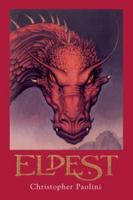
Book Review: Eldest by Christopher Paolini, Book 2 of the Inheritance Trilogy


Darkness falls…despair abounds…evil reigns…

Eldest opens with Eragon looking upon the battlefield of Tronjheim. It has been three days since the battle has been won, three days since Eragon killed the Shade Durza. But the mood is bleak, there is no rejoicing over the victory. The stronghold of the dwarves and the Varden — Farthen Dur is littered with bodies. So many have been killed and the battlefield is so wet with blood that it soaks through the soles of Eragon's boots. The battle is over for now, but every one knows that King Galbatorix has not been completely defeated.

And Eragon himself is scarred and fragile. Though he managed to kill Durza and is now known as Shadeslayer, Durza's sword has left a battle injury so extensive that Eragon, "the only hope for resisting the Empire" of Galbatorix, wonders how a cripple like him will survive the inevitable conflicts ahead.

Then in a surprise attack, a group of Urgals murder Ajihad, the leader of the Varden and take the Twins and Eragon's friend, Murtagh prisoner. The Varden's Council of Elders wants to nominate a leader who'll be a puppet in their hands. They want Eragon to throw his weight behind them and swear allegiance to the Council. The dwarves too would like to have a say in the matter and want Eragon to support their choice. Arya, the ambassador of the elves, keeps her own counsel. Eragon is caught in these uneasy circumstances — a time of power games and strategizing.

So begins Eldest, the second book of the Inheritance Trilogy — with death and turmoil. In this eagerly awaited sequel to Eragon, Christopher Paolini continues the story of Eragon, a 16-year-old farm-lad and orphan who discovers his destiny as a Dragon Rider.

Readers will also know the fantastic story behind the publishing of the first book. Paolini wrote the story about a teenager and a dragon when he was 15. His parents published it. Paolini fulfilled his own destiny to be a writer — the book went on to become a best-seller in 2003.

Eldest, like the first book Eragon, is primarily about a boy and his dragon. But it is also a bit different. The author is now 21 and the writing has matured. While Eragon was essentially simplistic, Eldest is layered with other themes and multiple narratives. The writer also shows his skill in holding all of them together and blending them in the end for the climax.

Nasuada, with Eragon's support, takes her father's place leading the Varden. She decides to send Eragon and his dragon, Saphira, to Ellesméra where the elves will train them further in the arts of magic and war so that he can eventually be ready to fight Galbatorix.

In the elven forest city of Ellesméra, Eragon and Saphira are tutored in magic, battle skills, and the ancient language by the wise former Rider Oromis (the mourning sage, the cripple who is whole) and his elderly dragon Glaedr. It's here, during training, that Eragon comes to know the true extent of his battle injury. His back often explodes in pain, and he suffers seizures so bad that he feels powerless. Soon Eragon develops a fatalistic acceptance of his limitations and is plagued with self-doubt. He even wonders if he is the rider meant to take on Galbatorix or merely someone who is to pave the way for other possible riders.

Meanwhile, back at Carvahall, Eragon's village, his cousin Roran has returned from Therinsford to find that his cousin has disappeared, his father is dead, and his land is ruined. Roran, bitter about his father's death, blames Eragon, but he's not sure why-- he only feels that in some way Eragon has been responsible for all that happened. If only Eragon had not kept the strange stone (which turns out to be the egg from which Saphira hatched) that he had found in the Spine perhaps things would now be different. On his return, he had hoped to court the beautiful Katrina and eventually ask for her hand in marriage. However, he no longer has a home or farm and he has no money of his own that'll help him win the approval of Sloan, Katrina's father. Roran who was returning to Carvahall with the hope of putting his life together again is thus filled with an inexplicable resentment.

Roran soon becomes a target for Galbatorix because he is Eragon's cousin. The horrible creatures known as Ra'zac, are after him because they hope to get from him information about Eragon. Roran flees and hides in the mountains to save the village. But within a short time the village is under siege by Galbatorix's soldiers. Roran returns and organizes Carvahall to resist the Ra'zac and Galbatorix's soldiers. The Ra'zac however take Katrina captive and that event begins the true journey for Roran, and he discovers in himself an ability he never knew he possessed.

He leads the villagers away on a desperate escape over the mountains from Carvahall to the kingdom of Surda in a dangerous and frightening adventure to find both safety for them and a way to get Katrina back. And along the way, he comes to hear of a Dragon Rider who is brave, strong, and the hope of Alagaësia.

Paolini skillfully alternates between the stories Eragon and Roran, often also weaving in the story of Nasuada, the new leader of the Varden who has taken them to Surda to prepare for battle. And these narratives are interspersed with romance: Eragon's infatuation with Arya, the princess of the elves and Saphira, the only female dragon around, attraction towards her mentor, the dragon Glaedr.

The two narratives move surely and inevitably toward a massive battle with the forces of Galbatorix on the burning plains of Alagaësia. The battle, as in any fantasy, is of epic proportions and is vividly narrated by Paolini. In the midst of battle, Eragon finds that there's another enemy rider, more powerful and skilled than him. He and Saphira confront and fight the rider and his giant red dragon over a bloody battlefield but lose to the enemy rider's superior skill and power. Eragon learns a shocking secret about his parentage (an echo/influence of Star Wars?) during the duel and realizes that the prophecy that he'll be betrayed by his own blood has come true. Eldest ends with the promise of yet another dangerous journey, this time for a rescue and for revenge. More importantly Eldest ends with an ominous twist that sets up the third book that is to follow.

Like the hero of his book, Eragon, Christopher Paolini has grown up and matured a lot since the last book, Eragon, was written. He displays a better and more solid grip of the fantastic tradition (some might gripe that it is more fantasy and less novel). The novel, like any similar fantasy novel/classic heroic quest , has a predictable cast of characters and races: dragons that breath fire, the dwarves who love their stony realms, the noble elves who are one with nature, and the hero who is unaware of the true extent of his abilities and his destiny. But unlike Eragon — which seemed to have drawn heavily on the mythology established by the Lord of the Rings, Star Wars, and especially Ursula Le Guin's Earthsea series — Eldest is more of Paolini's book.

Paolini demonstrates his great skill at story telling and shows that he has awesome knowledge of the world — right from the regimented lives ants in an anthill, to metal work, to philosophy and art. His grasp on linguistics is commendable. The "ancient language" in his book, the languages of the elves and the dwarves (and to some extent, the story) show the influence of old Nordic languages and Scandinavian mythology.

Paolini's grasp on the "geography" and "history" of his tale is also amazing. With great skill, Paolini builds the background of his tale. He narrates the myths of the dwarves, explains their religion. He does the same for the elves, explaining their past and their present beliefs. He also explains the origin and the purpose of the Dragon riders. The political equations between the different races and kingdoms is also very well nuanced. But it is in describing the lay and details of his land that Paolini excels the most. Right from the underground city of Farthen Dur with its glory carved in stone, to enchanted forest city of the elves — Ellesméra, a fairy land where "the legends of old still bestride the earth," to the bleak and cruel Hadarac desert, Paolini is at his best when he is describing the beauties of the various places in his Alagaësia.

It is astonishing that a 21-year-old has written a fantasy novel of this caliber. The novel teems with monsters, dragons, elves, dwarves, wizards and witches, magical forests, lovely princesses, brave warriors and powerful spells. Eldest should easily be a hit with fans of fantasy.

Eldest, though mistaken as a children's book, has everything for all audiences. It will appeal to adults because it's creative, well-written, and though a fantasy, it touches on many an adult concern — the story may be fantastic, but a discerning reader will find that it has never "abandoned" the real world at all . Kids will love it because, after all it's a story about a boy and his dragon — it's imaginative, heroic, has enough with action and at the same time it is about growing up and assuming responsibility.

Many will never consider picking up a book that has a dragon on its cover. For once, overcome your misgivings and read Eldest (and Eragon). You'll be pleasantly surprised with the novel's richness and sophistication. Undoubtedly, you'll also be thrilled with a tale that is narrated, beyond any question, by a storyteller who loves and enjoys the tale he is weaving.

I am eagerly awaiting book three.

Friday, September 2, 2005

Google Purge

"Our users want the world to be as simple, clean, and accessible as the Google home page itself," said Google CEO Eric Schmidt at a press conference held in their corporate offices. "Soon, it will be."
As a part of the first phase of a new Google project, executives will destroy all copyrighted materials that cannot be searched by Google.

The Onion reports on Google's new project: Google Purge -- Google's plan to destroy all information it can't index.

Link via: India Uncut.

50 Coolest Websites 2005

Just came across Time Magazine's list of the 50 coolest websites of 2005. These are categorized under: Arts & Entertainment, Lifestyle, Health & Hobbies, News & Information, Shopping, and of course, Blogs.

Thursday, September 1, 2005

Publishing Newspapers During Disasters

Newspapers consider it a point of honor to continue publishing no mater how bad things get. What do they do if a natural disaster prevents them from printing the next day's edition? Imagine: What would the newspapers of Mumbai would have done if the July 26 cloudburst had prevented publication? What if the printing presses had gone under water?

The New Orleans Times-Picayune couldn't figure out how to publish a print edition on August 31, after Hurricane Katrina put much of the city under water. Rather than not publishing an edition, It published PDF pages of the paper on its website.

One wonders how people would have accessed (and printed -- I suppose that was the intention behind the PDF format) the website for the PDF edition when most of the city would be without electricity or even communication services. An online edition might be good for reaching the connected, but is of no use to people who are the victims of the disaster.

While The New Orleans Times-Picayune should be commended for continuing to publish even under such difficult circumstances, it should also give a thought to the resumption of its print edition at the earliest.

After the cloudburst of July 26, we in Ambernath (about 60 Kms from Mumbai) had no electricity for a few days. Most of us had no access to any news or any source of information. The only "connections" we had with the world were cell phones (and even they were not reliable -- the cell network too had gone on the blink). These cell phone conversations were our only source of news -- and it is through them that we first came to know about the size and scale of the disaster in Mumbai and in our adjoining areas. Our first "hard news" came about two days later when some newspapers were finally available in the town -- when the road links were finally restored.

I guess all newspapers should think about (and they already might have) -- about having their own disaster management plan -- a plan that covers not only publication but also the distribution of the newspaper.

Source: Poynter Online: Keep Publishing, No Matter How Bad It Gets