Showing posts with label Education. Show all posts

Tuesday, August 2, 2011

The Technology Affected Learner

Geetha Krishnan on the six ways in which technology has impacted learners and learning:


In case you are unable to watch the video here, visit this page:
TEDxGachibowli - Geetha Krishnan - The Technology Affected Learner

Monday, April 12, 2010

Extreemly Jarbeg

Over the weekend, I visited one of my college teachers. I was meeting him after quite some time, at least 3 months (and once upon a time, I would visit him at least twice a week. Alas, life!). It was good to once again talk at length of academics, books, teaching, the college, ex-students, the current lot of students and all that. And when you are talking to teachers at this time of the year, you just can't stay away from discussing examinations and students' performances.

After nearly an hour of conversation, I remarked, in the way ex-students are wont to do, that one doesn't get "good" students like us anymore. Earlier whenever I said something like that, I would get hardly get any reaction apart from a nod and perhaps a smile. I was surprised when my professor vehemently agreed witgh me and then deplored the "falling standards." Earlier whenever we touched upon this topic he would talk about how students these days hardly seem to read anything or their general lack of awareness even of the literary greats. This time he observed that it appeared thet students these days were not even reading trash (his summation of the Mills and Boons or the Twilight kind of stuff). When I remarked that the students couldn't be that bad he agreed and said that they actually were worse. And he offered the recent examinations as an example.

Now teachers will find this bit familiar. Assessing examination papers is one of the most soul-weary chores in a teacher's life (from my personal experience, I can say it ranks a little above taking the daily roll call in a class). Teachers normally look at things to enliven these dreary chores. During paper assessments, it is much fun to read out to each other, what students have put down in their papers —believe me, reading out bits and pieces of student's creative efforts can offer much mirth. This time around, my professor and the others in his department noted down certain spellings from some of the answer sheets. And my professor offered me that list as proof of his poor opinion about the current batch of students.

I have, with his permission, reproduced the list below. All the spellings were taken from the answer sheets of FYBA Communication Skills. (Apparently, FYBCOM Business Communication students are more creative and would give Shakespeare a complex when it comes to spelling or creating new words.)


apropriate
behafe
clarrification
commeetti
complant
durt
extreemly
famouse
forwerd
fourgat
fress
genretion
immidiate
janeration
jarbeg
knoise
last benchars
pichurs
problams
proplems
remaber
robaries
rutin
seprete
shoud
sujested
theafes
urbisthan
youngstards

As my professor pointed out, most of the spellings above make sense phonetically. But it does appear the students have only "heard" or "spoken" these words and never encountered them on a page.

After going through the list, I commiserated with his lot, both as a student and an ex-teacher, and offered to attend his lectures once again.
"No. You will be worse. . . lost without your MS Word."

He, as always, had hit bull's-eye.

Sunday, December 20, 2009

Tweet Trove 5 (13-20 December, 2009)

Arts, Culture, Literature
OPEN Magazine | Silent Bestsellers (Indian Writings in English) : http://www.openthemagazine.com/article/books/silent-bestsellers


Education, e-Learning

What Matters Now: http://sethgodin.typepad.com/seths_blog/2009/12/what-matters-now-get-the-free-ebook.html. Free e-book of ideas from 70 thinkers.

Humor

The most frequently asked question in webinars and workshops: http://brandon-hall.com/janetclarey/?p=1623

Internet, Science and Technology

The many uses of Twitter (+ The Six Twitter Types): http://www.ngonlinenews.com/news/many-users-of-twitter/


Sunday, December 13, 2009

Tweet Trove 4 (6-12 December, 2009)

Apologies for the delay in posting this one - No connectivity for most of yesterday and when finally I could access the Internet, data seemed to be percolating through thick molasses.

Arts, Culture, Literature
Classic Twitterature - University of Chicago students reinterpret great works of literature into Twitter-speak: http://www.nbcchicago.com/news/local-beat/Classic-Twitterature-78848847.html


Are Writers Using TMA (Too Many Acronyms)? : http://www.poynter.org/column.asp?id=78&aid=173933

Business and Economics
The wonderful world of Walt Disney (infographic) : http://www.busmanagement.com/news/walt-disney-productions/

Education, e-Learning
How iPhone Could Reboot Education - Abilene Christian University has a go: http://www.wired.com/gadgetlab/2009/12/iphone-university-abilene/

Top 125 Workplace eLearning Posts of 2009: http://www.elearninglearning.com/wpblog/top-elearning-posts-2009/

Humor
Facebook suggestions (ahem) : http://xkcd.com/672/

Internet, Science and Technology
In the Brain, Seven Is A Magic Number: http://www.physorg.com/news178220995.html#top

Gallery: The Year's Most Amazing Scientific Images | Popular Science: http://www.popsci.com/science/gallery/2009-12/gallery-years-most-amazing-scientific-images


Etcetera
"Can you break your culture of silence?" - Sunitha Krishnan's fight against sex slavery: http://on.ted.com/287S

If you can save some trees, why not save some lettuce? http://cafehayek.com/2009/12/save-the-spinach.html

Saturday, December 5, 2009

Tweet Trove 3 (29 November-5 December, 2009)

Arts, Culture, Literature

Business and Economics
Do prostitutes want prostitution to be legal? Is a pimp no different than a corporate manager? More Q&A: http://freakonomics.blogs.nytimes.com/2009/12/01/superfreakonomics-book-club-sudhir-venkatesh-answers-your-prostitution-questions/#more-22489


Education, e-Learning

e-book: Theory and Practice of Online Learning (caution: 484 pages; pdf): http://www.aupress.ca/books/120146/ebook/99Z_Anderson_2008-Theory_and_Practice_of_Online_Learning.pdf

Discursive Learning:Knowing "What is missing in educational curriculum is this sense of play, this sense of tinkering." http://discursive-learning.blogspot.com/2009/11/knowing.html


Humor
Elementary My Dear Watson: http://www.thedoghousediaries.com/?p=1096


If the Bible was magazines: http://www.collegehumor.com/article:1795235

Internet, Science and Technology


TwHistory: http://www.twhistory.com/?page_id=2. Intriguing use of Twitter.

An alternate oral history of the last decade - If Al Gore had won: http://2010.newsweek.com/essay/if-gore-had-won.html

The journey of a tweet -- How 'tweets' become worldwide news within a matter of minutes? http://www.ngonlinenews.com/news/the-journey-of-a-tweet/


The Seattle Times is using Google Wave to catching a killer: http://www.techcrunch.com/2009/11/30/google-wave-manhunt/

Etcetera


Rectangles Vs. Triangles: The Great Sandwich Debate : http://www.npr.org/templates/story/story.php?storyId=120914097

Saturday, November 28, 2009

Tweet Trove 2 (21-28 November, 2009)

Arts, Culture, Literature
"Publishing is changing. I’m ready to see what it turns into and change my expectations with it." http://bit.ly/1weHjv

How Twitter Makes You A Better Writer: http://www.copyblogger.com/twitter-writing/

Business and Economics
The amazing world of Coca-Cola (infographic): http://www.busmanagement.com/news/coca-cola/

Education, e-Learning
Educational games and interactivities from National Geographic: http://channel.nationalgeographic.com/channel/games

2009-2014 forecasts of the US market for e-learning: http://tinyurl.com/ydypry8. (Caution: pdf)

A Quick Guide to Social Learning - 100+ examples of the use of social media in learning: http://c4lpt.co.uk/handbook/examples.html

Humor
Top 20 Unfortunate Lessons Girls Learn From Twilight: http://www.wired.com/underwire/2009/11/twilight-lessons-girls-learn/

Internet vices: Twitter is crack cocaine? Facebook = cranberry vodka? http://www.patrickmoberg.com/internet-vices/

The Chronicles of Narnia? http://xkcd.com/665/

8 ways to kill an idea: http://www.samiviitamaki.com/?p=336

Internet, Science and Technology

The story of the Titanic Gulp - big *is* beautiful: check out this lovely piece on how whales dine: http://bit.ly/6aBfh6

"Wikipedia is now part of the establishment" Fears over future of Wikipedia as 49,000 volunteers leave site: http://bit.ly/6PnDHN

A useful compendium: Jane Hart's Guide to Social Learning: http://icio.us/db40th

Evolution vs. Intelligent Design: 6 Bones of Contention: http://bit.ly/6mpg6N

Google Image Search meets the Visual Thesaurus: Google Image Swirl -- http://image-swirl.googlelabs.com/

Top 5 Misconceptions About The LHC : http://bit.ly/8tBx8G

Silence! The Last of the Giant Radio Telescopes Is Listening to the Universe http://bit.ly/1x4wzo

SETI: Building a Better Alien-Calling Code -- http://www.wired.com/wiredscience/2009/11/better-seti-code/

Friday, October 16, 2009

Nonsense Sharpens the Intellect

No, really. It does.

And that e-learning maven, Simply Speaking, tells us how this new research can help us design and develop better e-learning (or even traditional learning) programs.

But honestly, we should be ambitious in learning through nonsense. Getting a 1000 monkeys to bang away on a 1000 typewriters is what I would say is a good start.

Thursday, March 19, 2009

Training to Bring About a Behavioral Change

How effective is training in getting people to learn new behaviors? What if the expected behavior is contrary to the nature of the person? (Can you get a salesperson to actually listen to clients and not smother them in sales-speak?) One of the most articulate musings on the role and relevance of training in bringing about behavioral change: Changing Behavior.

Monday, May 22, 2006

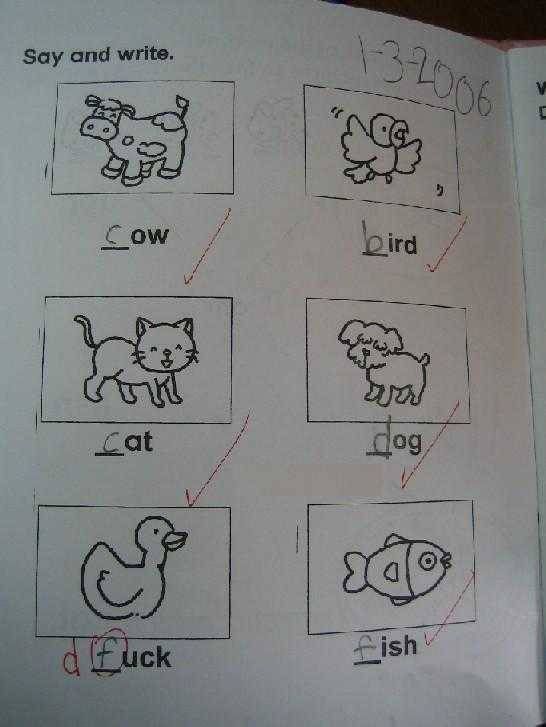
Who Says Kids are Innocent?

Got this as an email forward:


Click the image to enlarge it.

[Via email from Vinod]

Education is About the Books

American textbooks are:
[. . .] light as a feather intellectually, flitting briefly over too many topics without examining any of them in detail. Worse, too many of them are pedagogically dishonest, so thoroughly massaged to mollify competing political and identity-group interests as to paint a startlingly misleading picture of America and its history.Textbooks have become so bland and watered-down that they are “a scandal and an outrage,” [. . .] they are poorly written, they are burdened with irrelevant and unedifying content, and they reach for the lowest common denominator.

Textbooks have become so bland and watered-down that they are “a scandal and an outrage,” the Thomas B. Fordham Institute, a nonprofit education think tank in Washington, charged in a scathing report issued a year and a half ago.

“They are sanitized to avoid offending anyone who might complain at textbook adoption hearings in big states, they are poorly written, they are burdened with irrelevant and unedifying content, and they reach for the lowest common denominator,” Diane Ravitch, a senior official in the Education Department during the administrations of Presidents George H.W. Bush and Bill Clinton, wrote in the report’s introduction.

“As a result of all this, they undermine learning instead of building and encouraging it,” she added.
Read A textbook case of failure which contends that one of the reasons that the USA is falling behind (in comparison to India and China) in producing highly educated, intellectually flexible workers is bad textbooks. US textbooks, the article claims are all about appeasing the ruling political system yielding therefore materials that are shallow and misleading.

Wouldn't this be, to a certain extent, true of our educational system too? After all we have had our share of brouhaha over various textbooks in the past (especially, when a new government came into power, or educational committees changed).

The watering-down of textbooks is something that is even more serious. Take the example of English. My elder brother had awesome textbooks for all his years in school. Three years later, when I reached the same grade, the books were strictly ok - only a few of the lessons were interesting. Today what the kids get to read is only short passages, followed by a list of questions that check basic comprehension.

I remember participating in a teachers' seminar on "Communication Skills" a few years back. This is a compulsory course for all the first year degree college students. The course has got nothing to do with communication skills: Students get a number of reading passages and they answer simple comprehension questions. There's a bit of syllabification and word stress identification. Communication Skills classes have some of the lowest attendances by students -- unless a sadist teacher makes attendance compulsory. One of the many sessions in that seminar was one on how to get the students to attend these classes (and not on how to make the course interesting). One of the participants remarked that she doesn't follow the prescribed "official" books for the course. Students in her college pick up two books for the year -- one fiction, the other non-fiction -- and most of the learning objectives of the course are applied to these books. They also regularly go "beyond the syllabus" and discuss other aspects of the books. She remarked that the college never had a problem with low attendance in their communication skills classes.

I remember some of the Communication Skill Experts (people who had set the syllabus for the university) upbraided the teacher and the college for going beyond their brief -- "The syllabus is prescribed by experts with a particular reason and objective. Don't dare to do things you for which you have no authority."

To which the poor teacher replied, "But we are only trying to make a drab course interesting."

The books in our educational systems too "undermine learning instead of building and encouraging it."

Monday, November 28, 2005

Top 20 Edu Blogs

If you are interested in Education and elearning, I just came across this list, compiled by Glenn Malone, of the top 20 Edu Blogs.

You'll find a more comprehensive list here: Learning & Technology Blogs.